The short answer
An AI voice is fine for drafts, scratch tracks and internal videos that only your team will hear. For an ad, where the voice has to make someone feel something and remember your name, use a real person. A human reads the meaning behind the words, says your brand and place names right, and changes the read the moment you ask. Many teams use both: AI to time the edit, a real voice for the final.
I’m a voice actor, so you know where I stand. Every word I record is me, at a real microphone. But AI voices have a place, and pretending they don’t wouldn’t help you decide. This guide is the honest version.
1. Where an AI voice makes sense
- Scratch tracks. You need something to cut the video to and show the client before the script is final. An AI read is quick and cheap for that.
- Internal videos. A quick update for your own staff, where nobody outside the company will hear it.
- Testing a script. Hearing a draft out loud shows you which lines are too long or hard to follow.
- Lines that change every week. Some content is rebuilt so often that re-recording it each time isn’t practical.
What these have in common: nobody is deciding whether to buy from you because of how the voice sounds.
2. Where a real voice earns its fee
An ad is different. You have 30 seconds to sound like a company someone wants to trust. That’s where the small things a person does without thinking start to matter.
- The read behind the words. A slight pause before the offer. Warmth on your company name. A smile you can hear on the last line. That comes from understanding what the ad is trying to do, not from reading the words in order.
- Names said right. Brand names, people’s names and place names trip up AI voices. Here, Gloucester is said “GLOSS-ter”. A person asks before guessing. A voice engine just guesses.
- Direction. In a live session you say “a bit warmer” or “less salesy”, and the next take is different. You can direct me live over Source-Connect or a video call.
- Knowing who owns what. With a voice actor, you know exactly whose voice it is and what you’re allowed to do with the recording, because it’s in the quote.
Listeners are also getting better at spotting a synthetic voice. When they hear one in an ad, the brand can come across as cutting corners. That’s the opposite of what you’re paying for the ad to do.
3. Side by side
| AI voice | Real voice actor | |
|---|---|---|
| Speed | Minutes | Most of my jobs are delivered in under 24 hours |
| Cost | Low, often a monthly subscription | Quoted per job, based on where and how long the ad runs |
| Emotion and timing | Even and safe. Hard to get a specific feeling | Read to the meaning and to your edit |
| Names and tricky words | Guesses, then you fix it by hand | Asks, then says it right |
| Direction | Change the settings and try again | Live session: you give a note, the next take changes |
| Changes later | Regenerate it | One free revision of up to 50 words, plus pickups |
| Rights | Depends on the tool’s terms | Written into your quote |
| Best for | Drafts, scratch tracks, internal video | Ads, brand videos, anything a buyer will hear |
Hear the difference for yourself. More real spots on my commercials page.
4. Before you run an AI voice in an ad, check these
- The licence. Does the tool’s plan allow paid advertising, or broadcast on TV and radio? Free and cheap plans often don’t.
- Whose voice it is. Many AI voices are built from real people. Was that person asked, and paid? You don’t want your ad to be the one people ask that question about.
- Phone calls. In the US, the FCC ruled in 2024 that AI-generated voices in robocalls count as “artificial” voices, so the same consent rules apply. If your message goes out as phone calls, check with whoever handles your compliance.
- Political ads. A growing number of states have rules about AI in political ads, including labelling. Check the rules where your ad runs.
5. Using both: AI for the draft, a real voice for the final
This is how a lot of teams work now, and it’s a good way to work.
- Write the script and make an AI scratch track.
- Cut your video to the scratch and get the script signed off.
- Send me the final script, the length you need and your cut, if you have it. I’ll time the read to fit.
- Direct the session live if you want to, or just tell me the feel you’re after.
- Drop the real read into your edit in place of the scratch.
Not sure how long your script will run? My guide on how long a voice over runs has a timer you can paste your script into.
What you get from me
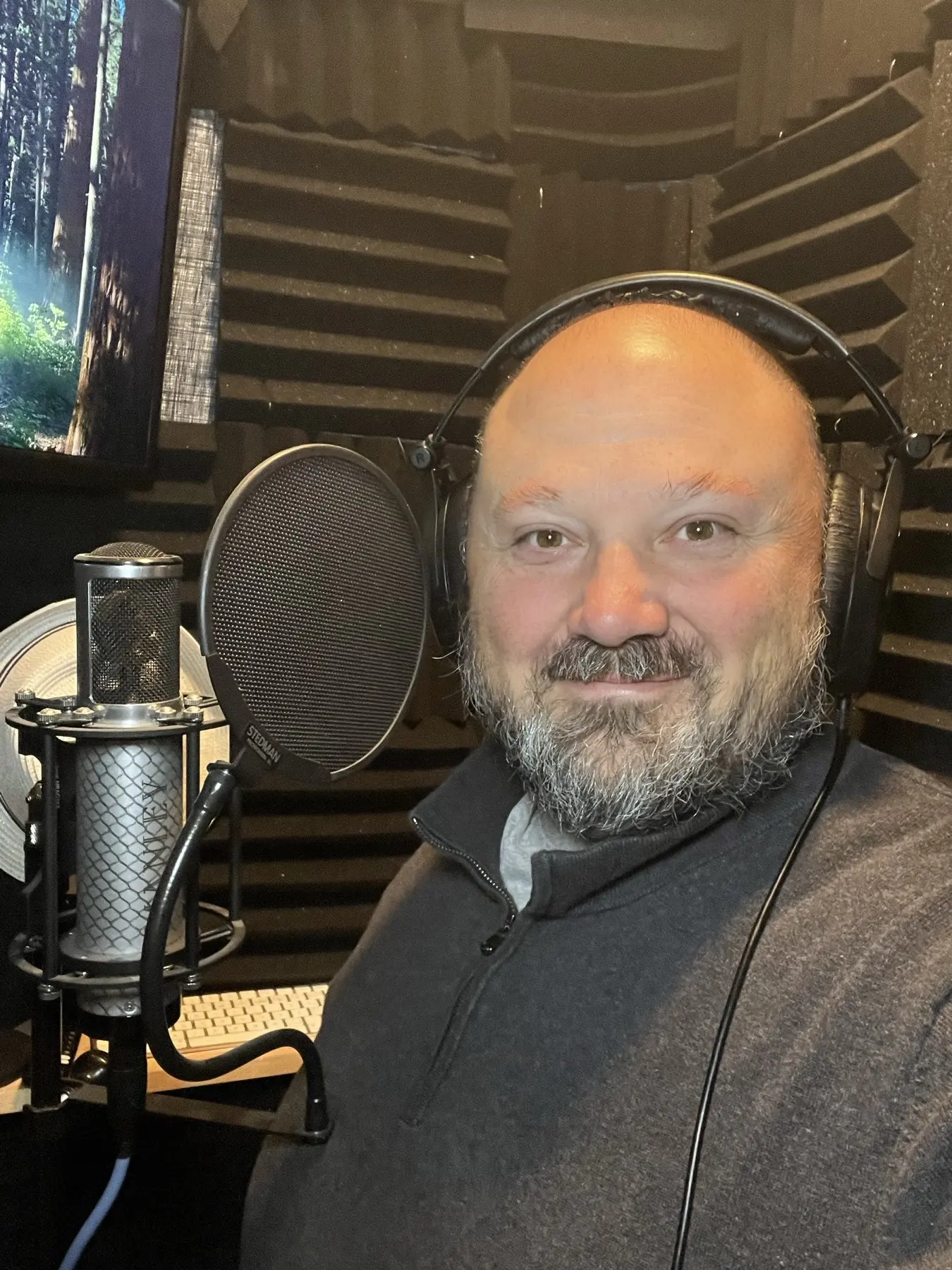
Every word is me, recorded in my own professional booth in Gloucester, Virginia, on a Manley tube microphone. Most jobs are delivered in under 24 hours, edited and mastered, in the format you need. You can direct the session live over Source-Connect or a video call. And you get one free revision of up to 50 words, plus pickups, so the final read fits your edit exactly.
Quick questions
Can people tell an AI voice from a real one?
Often, yes, and they’re getting better at it. It’s easiest to hear in longer reads and anything with feeling in it.
Is an AI voice cheaper?
Usually, yes. A voice actor is quoted on where the ad runs and for how long. Send me the details and I’ll quote it.
Can I use AI for the scratch and you for the final?
Yes. Send me the final script, the length and your cut, and I’ll time the read to fit.
Do you use AI voices?
No. Every word you hear from me is me, a real person, at a real microphone.
How fast can you deliver?
Most jobs are delivered in under 24 hours. If you need it the same day, say so when you send the script.
Want the real read?
Send me your script, the length and where the ad will run. You’ll get a free quote, usually within a few hours.
More for marketers: Commercial voice over · How long will my voice over run? · More guides for buyers