What do you need for a quote?
The word count, the genre and a sample chapter. If you have a release date in mind, include it.
Audiobooks and long-form narration
The short answer
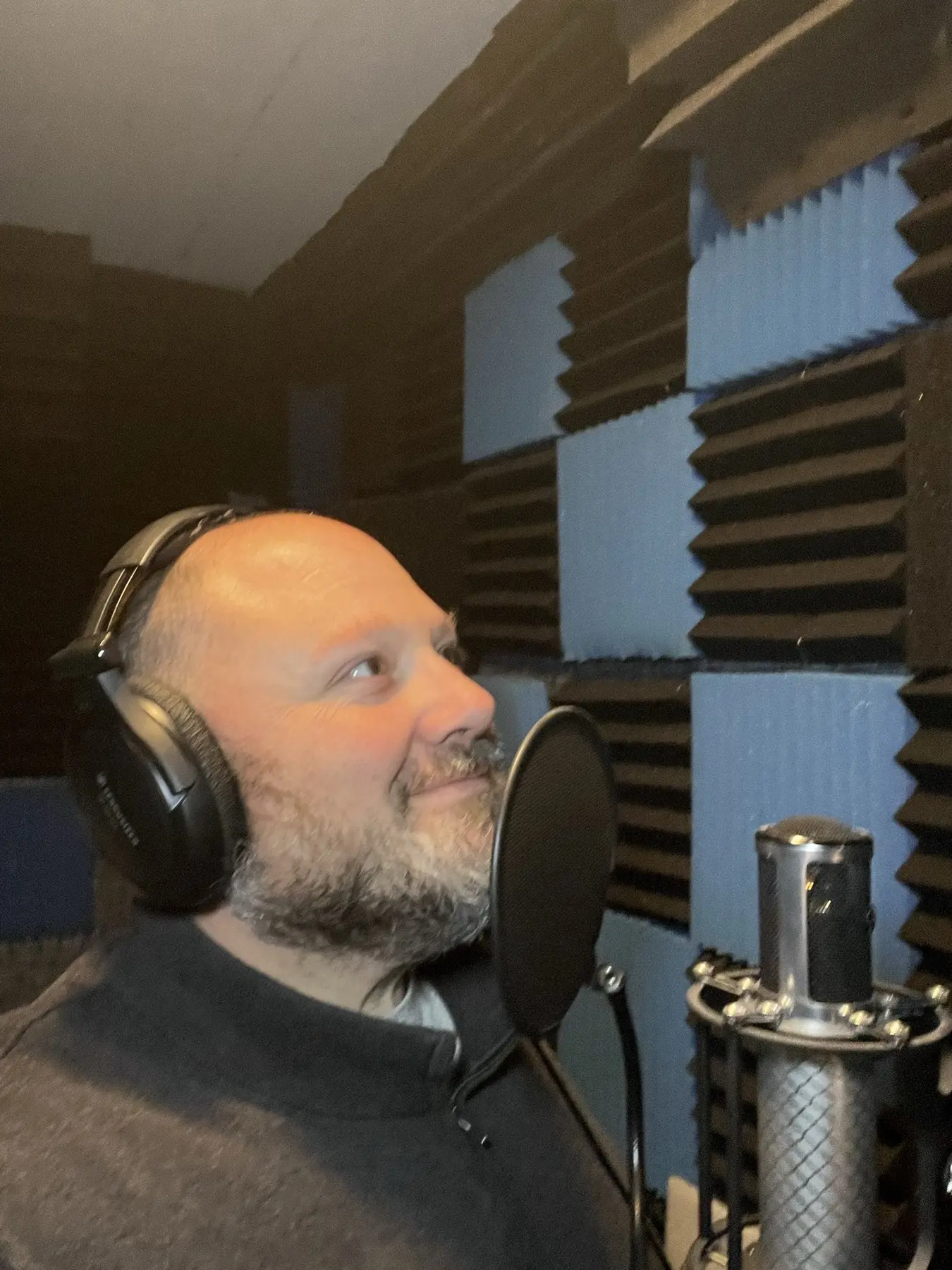
Anthony Pica is an American male audiobook narrator who records fiction and non-fiction from a professional booth in his own studio in Gloucester, Virginia. He has narrated classics including The Legend of Sleepy Hollow, Rip Van Winkle and The Raven for Academy Voices, his audiobook company, which has published more than 810 audiobooks. He spent 21 years in theatre as an actor and teacher. Send your word count and a sample chapter for a free quote.
Demos
Five classics I narrated for Academy Voices, my audiobook company, plus the opening of The Great Gatsby. Each sample is a short excerpt from the start of the book. Hear all my audiobooks on Academy Voices.
Washington Irving’s ghost story: the opening, where the valley and its spell are set up.
By Washington Irving. Hear the full audiobook on Academy Voices
In the bosom of one of those spacious coves which indent the eastern shore of the Hudson, at that broad expansion of the river denominated by the ancient Dutch navigators the Tappan Zee, and where they always prudently shortened sail and implored the protection of St. Nicholas when they crossed, there lies a small market town or rural port, which by some is called Greensburgh, but which is more generally and properly known by the name of Tarry Town.
This name was given, we are told, in former days, by the good housewives of the adjacent country, from the inveterate propensity of their husbands to linger about the village tavern on market days. Be that as it may, I do not vouch for the fact, but merely advert to it, for the sake of being precise and authentic.
Not far from this village, perhaps about two miles, there is a little valley or rather lap of land among high hills, which is one of the quietest places in the whole world. A small brook glides through it, with just murmur enough to lull one to repose; and the occasional whistle of a quail or tapping of a woodpecker is almost the only sound that ever breaks in upon the uniform tranquillity.
I recollect that, when a stripling, my first exploit in squirrel-shooting was in a grove of tall walnut-trees that shades one side of the valley. I had wandered into it at noon time, when all nature is peculiarly quiet, and was startled by the roar of my own gun, as it broke the Sabbath stillness around and was prolonged and reverberated by the angry echoes. If ever I should wish for a retreat whither I might steal from the world and its distractions, and dream quietly away the remnant of a troubled life, I know of none more promising than this little valley.
Poetry: the first three verses of Poe’s poem, keeping the rhythm without letting it turn sing-song.
By Edgar Allan Poe. Hear the full audiobook on Academy Voices
Once upon a midnight dreary, while I pondered, weak and weary, over many a quaint and curious volume of forgotten lore, while I nodded, nearly napping, suddenly there came a tapping, as of some one gently rapping, rapping at my chamber door. “’Tis some visitor,” I muttered, “tapping at my chamber door. Only this and nothing more.”
Ah, distinctly I remember it was in the bleak December; and each separate dying ember wrought its ghost upon the floor. Eagerly I wished the morrow; vainly I had sought to borrow from my books surcease of sorrow, sorrow for the lost Lenore, for the rare and radiant maiden whom the angels name Lenore. Nameless here for evermore.
And the silken, sad, uncertain rustling of each purple curtain thrilled me, filled me with fantastic terrors never felt before; so that now, to still the beating of my heart, I stood repeating, “’Tis some visitor entreating entrance at my chamber door, some late visitor entreating entrance at my chamber door. This it is and nothing more.”
Irving again: the Catskill Mountains, the old Dutch village, and the first time we meet Rip.
By Washington Irving. Hear the full audiobook on Academy Voices
Whoever has made a voyage up the Hudson must remember the Catskill Mountains. They are a dismembered branch of the great Appalachian family, and are seen away to the west of the river, swelling up to a noble height, and lording it over the surrounding country. Every change of season, every change of weather, indeed, every hour of the day, produces some change in the magical hues and shapes of these mountains, and they are regarded by all the good wives, far and near, as perfect barometers.
When the weather is fair and settled, they are clothed in blue and purple, and print their bold outlines on the clear evening sky; but sometimes, when the rest of the landscape is cloudless, they will gather a hood of gray vapors about their summits, which, in the last rays of the setting sun, will glow and light up like a crown of glory.
At the foot of these fairy mountains, the voyager may have descried the light smoke curling up from a village, whose shingle-roofs gleam among the trees, just where the blue tints of the upland melt away into the fresh green of the nearer landscape. It is a little village of great antiquity, having been founded by some of the Dutch colonists, in the early times of the province, just about the beginning of the government of the good Peter Stuyvesant, may he rest in peace! And there were some of the houses of the original settlers standing within a few years, built of small yellow bricks brought from Holland, having latticed windows and gable fronts, surmounted with weathercocks.
In that same village, and in one of these very houses, which, to tell the precise truth, was sadly time-worn and weather-beaten, there lived many years since, while the country was yet a province of Great Britain, a simple, good-natured fellow, of the name of Rip Van Winkle.
A Grimm fairy tale with some character work: the frightened miller’s daughter and the strange little man.
By Jacob & Wilhelm Grimm. Hear the full audiobook on Academy Voices
By the side of a wood, in a country a long way off, ran a fine stream of water; and upon the stream there stood a mill. The miller’s house was close by, and the miller, you must know, had a very beautiful daughter. She was, moreover, very shrewd and clever; and the miller was so proud of her, that he one day told the king of the land, who used to come and hunt in the wood, that his daughter could spin gold out of straw.
Now this king was very fond of money; and when he heard the miller’s boast his greediness was raised, and he sent for the girl to be brought before him. Then he led her to a chamber in his palace where there was a great heap of straw, and gave her a spinning-wheel, and said, “All this must be spun into gold before morning, as you love your life.”
It was in vain that the poor maiden said that it was only a silly boast of her father, for that she could do no such thing as spin straw into gold: the chamber door was locked, and she was left alone. She sat down in one corner of the room, and began to bewail her hard fate; when on a sudden the door opened, and a droll-looking little man hobbled in, and said, “Good morrow to you, my good lass; what are you weeping for?”
“Alas!” said she, “I must spin this straw into gold, and I don’t know how.” “What will you give me,” said the hobgoblin, “to do it for you?” “My necklace,” replied the maiden.
Another Grimm tale, told simply: a king, three sons and the bird that steals his golden apples.
By Jacob & Wilhelm Grimm. Hear the full audiobook on Academy Voices
A certain king had a beautiful garden, and in the garden stood a tree which bore golden apples. These apples were always counted, and about the time when they began to grow ripe it was found that every night one of them was gone. The king became very angry at this, and ordered the gardener to keep watch all night under the tree.
The gardener set his eldest son to watch; but about twelve o’clock he fell asleep, and in the morning another of the apples was missing. Then the second son was ordered to watch; and at midnight he too fell asleep, and in the morning another apple was gone. Then the third son offered to keep watch; but the gardener at first would not let him, for fear some harm should come to him: however, at last he consented, and the young man laid himself under the tree to watch.
As the clock struck twelve he heard a rustling noise in the air, and a bird came flying that was of pure gold; and as it was snapping at one of the apples with its beak, the gardener’s son jumped up and shot an arrow at it. But the arrow did the bird no harm; only it dropped a golden feather from its tail, and then flew away.
The golden feather was brought to the king in the morning, and all the council was called together. Everyone agreed that it was worth more than all the wealth of the kingdom: but the king said, “One feather is of no use to me, I must have the whole bird.”
Classic fiction: the opening of F. Scott Fitzgerald’s novel, read as Nick Carraway.
“The Great Gatsby” by F. Scott Fitzgerald.
In my younger and more vulnerable years my father gave me some advice that I’ve been turning over in my mind ever since. “Whenever you feel like criticizing anyone,” he told me, “just remember that all the people in this world haven’t had the advantages that you’ve had.”
He didn’t say any more, but we’ve always been unusually communicative in a reserved way, and I understood that he meant a great deal more than that. In consequence, I’m inclined to reserve all judgments, a habit that has opened up many curious natures to me and also made me the victim of not a few veteran bores.
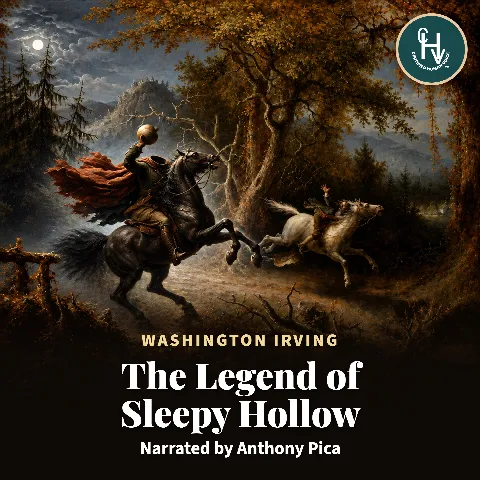
Every book I’ve narrated for Academy Voices, with full samples.
How I narrate a book
A book is a long time to spend with one voice. My job is to stay out of the way of the story while giving every character and every idea what it needs. Twenty-one years in theatre taught me to read a whole script before I make a single choice, and I do the same with a book.
Send the manuscript, a list of names and words that need a set pronunciation, and anything you already know about how a character should sound.
Academy Voices is my audiobook company. It has published more than 810 audiobooks, every one read by a real person. If you’re an author and want a team to take your book from manuscript to finished audiobook, see how it works for authors.
Quick facts
| Voice | Warm, clear American male · vocal age 18–54 |
|---|---|
| Accents | Neutral American, Southern American |
| Books | Fiction and non-fiction |
| Schedule | Agreed up front, based on the length of the book |
| Files | Edited and mastered, one file per chapter |
| Pronunciation | Send a list of names and terms; I ask before I guess |
| Live sessions | Live directed sessions over Source-Connect, or a video call |
| Studio | Professional booth built in my studio in Gloucester, Virginia, with a Manley tube microphone |
| Quotes | Free, and I reply personally |
What to send
Word count, genre, a sample chapter and your target release date.
I read the sample, ask about characters and pronunciation, and send a quote and a schedule.
Recorded in my booth, edited and mastered, one file per chapter.
Questions
The word count, the genre and a sample chapter. If you have a release date in mind, include it.
Yes, fiction and non-fiction. The samples on this page are classic fiction, poetry and fairy tales from audiobooks I’ve narrated.
Send a pronunciation list with the manuscript. I’ll ask about anything that isn’t on it rather than guess.
Yes, if you’d like to. Ask for the book in batches and you can give notes before I get too far ahead.
On Academy Voices. My narrator page lists every audiobook I’ve narrated there, each with a sample.
My audiobook company. It has published more than 810 audiobooks, all narrated by real people. Authors who want the whole production handled can start here.
No. Every word of your book is read by me, a real person.
Free quote
Send the word count, genre and a sample chapter. You’ll get a free quote and a schedule.