The short answer
Keep each stop to about one to two minutes, which is roughly 150 to 300 words. Open every stop by pointing at something the visitor can see, tell one story, and end with a line that sends them on to the next stop. Write the way a good guide talks, not the way a wall label reads. Lay the script out one row per stop with a stop number, and add a pronunciation guide for every name and place. Then read the whole thing out loud standing in front of the objects before it goes to the narrator.
A wall label is read at the visitor’s own pace. An audio tour is heard once, while they’re standing up, looking at something, maybe holding a child’s hand. That changes how you write it. The good news is that the fixes are simple, and most of them happen before anyone records a word.
1. Decide how long each stop should be
Most visitors give a stop one to two minutes before they start to drift. Narration for a tour runs at about 150 words a minute, a little slower than an ad, so that works out to:
| Stop length | About this many words | Good for |
|---|---|---|
| 30–45 seconds | 75–110 | Directions, a quick object, a welcome |
| 1–2 minutes | 150–300 | Most stops |
| 2–3 minutes | 300–450 | A few big moments only, like a main room or a key object |
If a stop needs more than three minutes, split it into two stops, or add an optional “want to hear more?” track the visitor can choose. Paste a stop into the timer on my guide to how long a voice over runs to check it.
2. Give every stop the same shape
A simple pattern keeps visitors oriented, and it makes the script easier to write:
- Look. Start with something they can see right now. “Look up at the ceiling above the fireplace.”
- Tell one story. One person, one moment, one reason this thing matters. Not everything you know about it.
- Send them on. End with where to go next. “When you’re ready, walk through the door on your left to stop 7.”
The “look” line is the one most scripts skip, and it’s the one that makes a tour feel like someone is standing next to you.
3. Use a stop-by-stop layout (copy this)
One row per stop, in Word, Google Docs or a spreadsheet. Only one column gets read aloud.
| Stop / file name | Narration (read aloud) | Where / notes (not read) |
|---|---|---|
| 01_Welcome | “Welcome to the house. Before you go in, turn around and look at the river. In 1781, this view was full of ships.” | Front porch. Keep under 45 seconds. |
| 02_Hall | “Look at the floorboards by the stairs. Those dark marks are from the night the family…” | Entrance hall, by the staircase. |
| 02b_Hall_More | “Want to know what happened next? Here’s the rest of the story…” | Optional deeper track. |
The stop number in the first column becomes the file name, so the files drop straight into your app or player in the right order.
4. Write it like a guide talks
- Talk to one person. “You” and “look”, not “visitors will observe”.
- Short sentences. One idea each. A listener can’t reread a long one.
- Say dates the way people say them. “In the spring of 1781”, not “c. 1781–82”.
- Cut the catalog details. “Oil on canvas, 34 by 46 inches” belongs on the label.
- Use real voices when you have them. A line from a letter or diary, read as a quote, does more than a paragraph of summary.
- Don’t read the label. The visitor can see it. Tell them what the label doesn’t.
5. The pronunciation guide
Tours are full of names a narrator can’t guess: families, towns, rivers, ships and native place names. Some local names are said differently from how they’re spelled, and visitors from nearby will notice if they’re wrong.
| Word | Say it like | Notes |
|---|---|---|
| Gloucester | GLOSS-ter | Virginia county |
| Powhatan | POW-uh-tan | Check with your tribal or local historians |
| Rappahannock | rap-uh-HAN-uck | River |
| [Your name] | [sounds like] | A voice memo from your curator settles it |
Warm and unhurried, for a 1905 mansion and the people who lived in it. More museum and tour narration.
6. Write the directions carefully
The line that gets people lost is usually the direction, not the history. Use things they can see (“the door with the red frame”) rather than compass points, say left and right from where they’re standing at the end of the stop, and walk the route yourself with the script in hand. For walking and driving tours, keep the directions in their own short files so you can update a turn without re-recording the story.
7. Plan for changes
Exhibits move and objects go out on loan. Keep stops self-contained, so one can be replaced without touching the ones around it, and avoid lines like “as we saw two stops ago”. Ask your narrator whether they can match the sound of the original if you add a stop next year.
8. Checklist before you send it
- Every stop has a number, a location and a rough length.
- Each stop starts with something to look at and ends with where to go next.
- Read out loud, on site, start to finish.
- Dates, numbers and names written the way they’re said.
- Pronunciation guide filled in, with a voice memo for anything tricky.
- File format your app or player needs (WAV or MP3).
- Who the visitor is, in one line (“families with kids”, “school groups”).
- Your opening date, and who answers questions about the script.
What you get from me
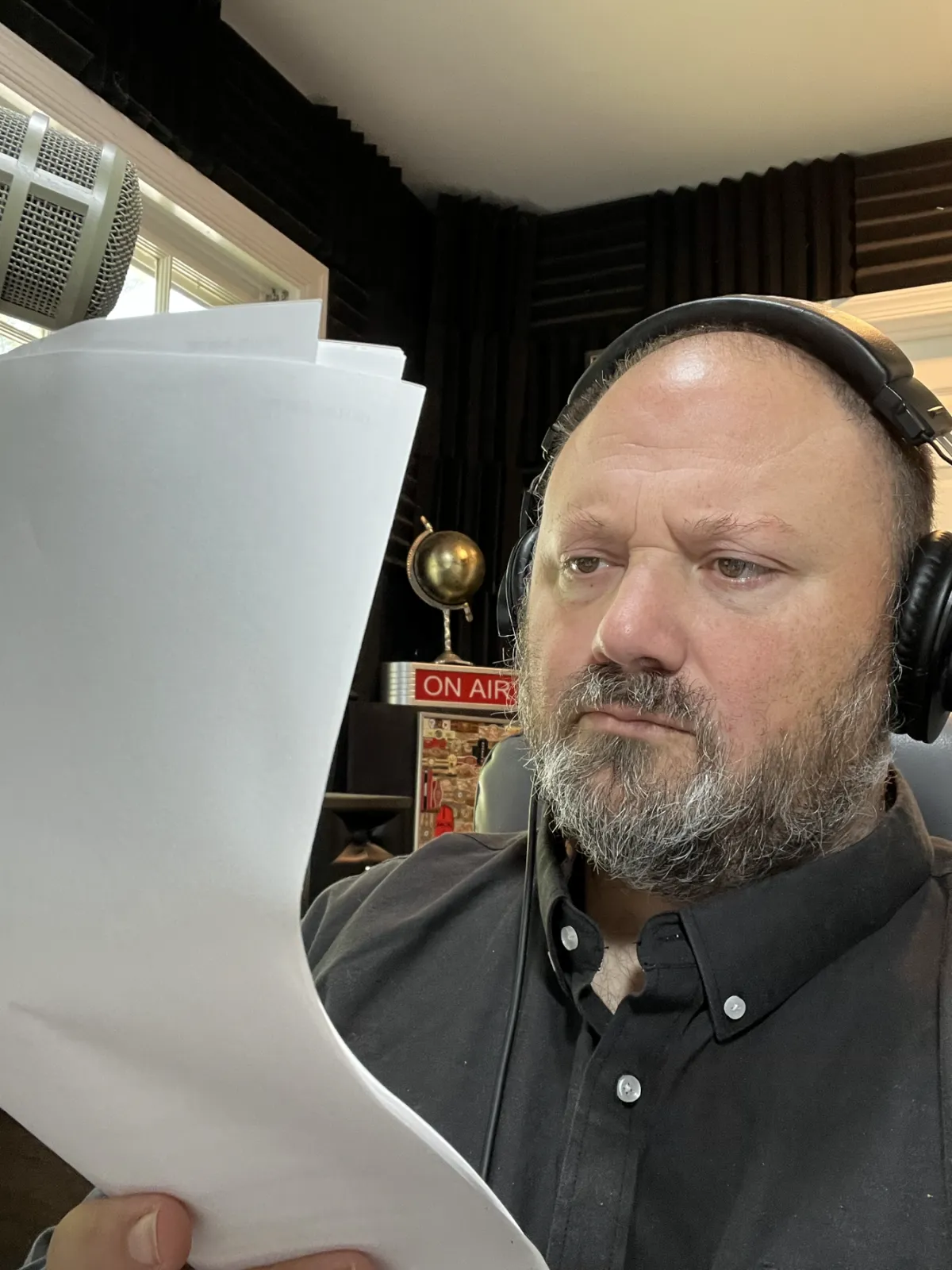
I read the whole tour before I record and send any questions first, including any names I need to check. Your team can direct the session live over video if you want to hear it as it’s recorded. I record in my own professional booth in Gloucester, Virginia, across the river from Yorktown, and every stop comes back as its own edited file, numbered to match your stop list. I keep the session settings, so a stop you add later still sounds like the rest of the tour. Every job includes one free revision of up to 50 words, plus pickups.
Quick questions
How long should an audio tour stop be?
About one to two minutes, or 150 to 300 words. Save longer stops for a few big moments, and offer optional extra tracks for people who want more.
How many stops should an audio tour have?
Plan around how long people stay. A one-hour visit with time to walk and look usually fits 15 to 25 stops of one to two minutes each.
Should the narrator be the same voice as our film?
It helps. Visitors who watched the welcome film will feel the tour belongs to the same place.
Can one narrator voice quotes from historical people?
Yes. A shift in tone is usually enough to show it’s a quote. For a full cast of voices, plan that before you write.
How do I get a quote?
Send the script or a word count, the number of stops, and where it will be heard. I usually reply within a few hours.
Tour script ready?
Send it over, or the word count and number of stops, and I’ll come back with a free quote, usually within a few hours.
More for museums and sites: Museum & audio tour narration · Documentary & narration · Hiring a voice actor in Virginia · More guides for buyers